
 Rev. Padre Víctor Caviedes
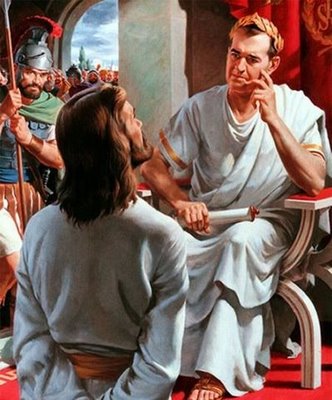
Dentro del proceso en el que se va a decidir la ejecución de Jesús, el evangelio de Juan ofrece un sorprendente diálogo privado entre dos personajes: Pilato, representante del imperio más poderoso de la Tierra y Jesús, un reo maniatado que se presenta como testigo de la verdad.
Precisamente, Pilato quiere, al parecer, saber la verdad que se encierra en aquel extraño personaje que tiene ante su trono: «¿Eres tú el rey de los judíos?» Jesús va a responder exponiendo su verdad. Veamos algunas diferencias mas:
-Pilatos representante del Cesar en Israel, no es un gobernante de nuestro tiempo, ciertamente, pero representa el espíritu de los gobernantes de nuestro mundo de todos los tiempos:
a) Tiene poder y capacidad de decisión sobre todos sus siervos/súbditos
b) Tiene ejercito y policías para mantener “su orden” establecido.
c) Vive en medio de lujos, comodidades y placeres de este mundo.
d) Se siente todopoderoso, como si estuviera por encima del bien y del mal.
-Jesús es diferente, no es rey al estilo que Pilato puede imaginar ni pretende ocupar el trono de Israel ni disputar a Tiberio su poder imperial además
a) No tiene súbditos, sino “hermanos” y “amigos”
b) No tiene ejército, ni armas, ni capacidad bélica alguna, “su orden” es la paz y el amor entre las personas, no la dominación por la fuerza
c) Vive humildemente sin lujos, a la altura de sus discípulos y de la gente que le seguía. Sin posesiones, ni dinero en los bancos.
d) Domina más que un territorio concreto. Porque es REY DEL UNIVERSO, pero no presume de ello, ni va luciendo su título o sus honores.
- Precisamente, Pilato quiere, al parecer, saber la verdad que se encierra en aquel extraño personaje que tiene ante su trono: «¿Eres tú el rey de los judíos?» Jesús va a responderle «Mi reino no es de este mundo». Y es que Jesús no pertenece a ese sistema en el que se mueve el prefecto de Roma, sostenido por la injusticia y la mentira. No se apoya en la fuerza de las armas. Tiene un fundamento completamente diferente. Su realeza proviene del amor de Dios al mundo. Además dice Jesús que si su reino fuera de este mundo “habría enviado sus ejércitos para que no cayera en manos de los judíos”, pero su Reino no es de aquí.
-Jesús es rey, sí, pero no de este mundo. Es rey del Universo, rey del cielo. Y en el cielo las cosas no funcionan como en este mundo. En el cielo no existen los males y las perversidades de nuestro mundo, ocasionados entre otras cosas por los malos reyes y gobernantes de este mundo. En el cielo no hay ejércitos, ni guerras, ni galones, ni estructuras jerárquicas, ni desigualdades, ni injusticias… mientras que en el mundo gobiernan los hombres, llenos de pecados e imperfecciones. En el cielo gobierna Dios, que es perfecto y no comete errores. Por eso las cosas van bien allí y van mal aquí.
- Jesús añade a su respuesta a Pilatos, algo muy importante «Soy rey...y he venido al mundo para ser testigo de la verdad». Es en este mundo donde Jesús quiere ejercer su realeza, pero de una forma sorprendente. No viene a gobernar como Tiberio sino a ser «testigo de la verdad» introduciendo el amor y la justicia de Dios en la historia humana.
- Esta verdad que Jesús trae consigo no es una doctrina teórica. Es una llamada que puede transformar la vida de las personas. Lo había dicho Jesús: «Si se mantienen fieles a mi Palabra...conocerán la verdad y la verdad los hará libres». Ser fieles al Evangelio de Jesús es una experiencia única pues lleva a conocer una verdad liberadora, capaz de hacer nuestra vida más humana.
- Y esa es una de las grandes diferencias con los reyes y gobernantes de nuestro mundo: no son servidores de la verdad.
a) algunos engañan a los ciudadanos para mantenerse en el poder.
b) Mienten descaradamente si les conviene para sus intereses.
c) Falsifican la información para que no se sepa la verdad.
-Nuestro mundo está lleno de mentira, de falsedades, de engaños y corrupciones. Y a veces pensamos que no nos podemos fiar de nuestros gobernantes y políticos, a veces con razón y a veces no.
-Pero de Jesús sí que nos podemos fiar. Porque El es el rey de la verdad, el nunca engaña, nunca miente. No busca el poder para él, sino que quiere el bien para todos. No ha venido a servirse, sino a ser “servidor de los demás” y a dar su vida en rescate por todos.
-Nosotros podemos experimentar cierta decepción de nuestros reyes y gobernantes. Pero podemos tener plena confianza en Jesús, nuestro rey de la verdad. Por eso nosotros en este mundo tenemos que ser servidores del rey Jesús, contribuyendo a crear su reino ya aquí en nuestro mundo:
- Siendo defensores de la verdad y no de la mentira
- Siendo defensores de la justicia y no de la injusticia
- Siendo humildes y servidores y no orgullosos y prepotentes
- Siendo solidarios con los pobres, los enfermos, los inmigrantes.
- Siendo ….
Queridos hermanos y hermanas, nunca olvidemos que Jesucristo es la única verdad de la que nos está permitido vivir a los cristianos. ¿No necesitamos en la Iglesia de Jesús hacer un examen de conciencia colectivo ante el "Testigo de la Verdad"¿Atrevernos a discernir con humildad qué hay de verdad y qué hay de mentira en nuestro seguimiento a Jesús? ¿Dónde hay verdad liberadora y dónde mentira que nos esclaviza? ¿No necesitamos dar pasos hacia mayores niveles de verdad humana y evangélica en nuestras vidas, nuestras comunidades y nuestras instituciones?
In english
CHRIST THE KING SUNDAY
Within the process which
will decide the execution of
Jesus, the Gospel of John
offers a stunning private
dialogue between two
characters: Pilate,
representing the most
powerful empire on Earth,
and Jesus, a handcuffed
prisoner who appears as
witness truth.
Indeed, Pilate wants to
appear to know the truth
that lies in this strange
character who has before his
throne, 'Are you the King of
the Jews? "Jesus will
respond by exposing the
truth. Here are some more
differences:
-Pilate Caesar's
representative in Israel,
not a ruler of our time,
certainly, but represents
the spirit of the rulers of
our world of all time:
a) has power and decision
making on all his servants /
subjects
b) have an army and police
to maintain "its"
established.
c) Live in luxury, comforts
and pleasures of this world.
d) It feels powerful, as if
beyond good and evil.
"Jesus is different, style
is king can imagine that
Pilate is not intended to
occupy the throne of Israel
or to dispute to further
their imperial power
Tiberius:
a) Has no subjects, but "brothers"
and "friends"
b) Has no army, no weapons
or any weapon capability, "its"
is peace and love between
people, not rule by force
c) no-frills live humbly, to
the height of his disciples
and the people who followed
him. Without possessions, no
money in the banks.
d) Master over a specific
territory. Why is King of
the Universe, but it does
not boast, nor is wearing
his title or his honors.
- Precisely, Pilate wants to
appear to know the truth
that lies in this strange
character who has before his
throne, 'Are you the King of
the Jews? "Jesus will reply,"
My kingdom is not of this
world. " And Jesus does not
belong to this system that
moves the prefect of Rome,
supported by the injustice
and lies. It does not rely
on force of arms. It has a
completely different basis.
His royalty comes from love
of God to the world. Jesus
also said that if his
kingdom were of this world "would
have sent their armies to
avoid falling into Jewish
hands," but his kingdom is
not from here.
"Jesus is king, yes, but not
of this world. He is king of
the universe, king of heaven.
And in heaven and things do
not work in this world. In
heaven there is no evil and
the evils of our world,
caused inter alia by evil
kings and rulers of this
world. In heaven there are
no armies, no wars, or
gallons, or hierarchical
structures, or inequalities
or injustices ... while men
rule the world, full of sins
and imperfections. God
governs in the sky, which is
perfect and no mistakes. So
things are going well there
and go wrong here.
- Jesus adds to his answer
to Pilate, importantly, "I'm
king ... and I came into the
world to witness the truth."
It is in this world where
Jesus wants to exercise his
kingship, but in a
surprising way. It does not
come to rule as Tiberius but
to be a "witness of truth
'by introducing the love and
justice of God in human
history.
- This truth that Jesus
brings is not a theoretical
doctrine. It is a call that
can transform the lives of
people. Jesus had said: "If
they stay true to my word
... know the truth and the
truth shall make you free".
Being faithful to the Gospel
of Jesus is a unique
experience it has released a
liberating truth, able to
make our life more human.
- And that's one of the big
differences with the kings
and rulers of our world:
they are servants of the
truth.
a) some people cheat to stay
in power.
b) blatantly lie if it suits
them for their interests.
c) forging is not to know
the truth.
"Our world is full of lies,
falsehoods, deceptions and
corruptions. And sometimes
we think that we can not
trust our leaders and
politicians, sometimes
rightly, sometimes not.
"But Jesus did that we can
be trusted. For he is the
king of truth, never cheat,
never lie. Not seeking power
for himself, but wants good
for everyone. It has come to
be served, but to be "servant
of others" and to give his
life a ransom for all.
"We may experience some
disappointment of our kings
and rulers. But we have full
confidence in Jesus, our
king of truth. So we in this
world we must be servants of
King Jesus, helping to build
his kingdom here and in our
world:
- As defenders of the truth
and not lying
- Being champions of justice
and not injustice
- Being humble servants and
not proud and arrogant
- Being in solidarity with
the poor, the sick,
immigrants.
- Being ....
Dear brothers and sisters,
never forget that Jesus
Christ is the only truth
that we are allowed to live
the Christians. Do not we
need in the Church of Jesus
make a collective
examination of conscience
before the "Witness to Truth"
Dare to discern what's true
humility and what's lying in
our following of Jesus?
Where there is truth where
lie liberating and enslaving
us? Do not we need to move
towards higher levels of
human and evangelical truth
in our lives, our
communities and our
institutions?